

US Army Corps of Engineering (USACE) Levee Screening Tool 2.0
With nearly 10 million people who live or work behind their levees, the U.S. Army Corps of Engineers (USACE) is constantly striving to better understand the conditions of levees and their associated flood risks.
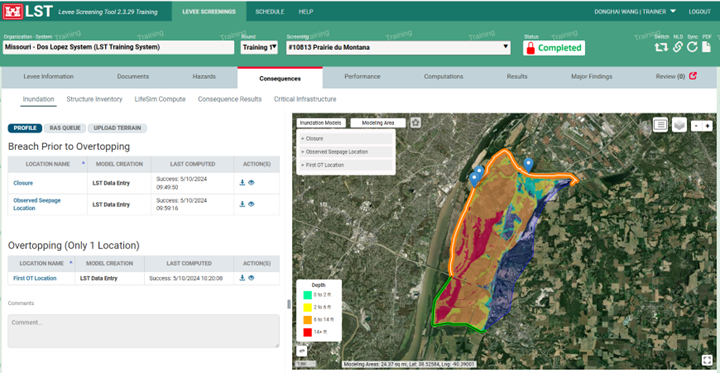
The USACE uses the Levee Screening Tool (LST), a web-based risk assessment tool and database, to support levee assessments nationwide. The provides a credible, efficient, and consistent approach for assessing levee risk with minimal analysis.
GEI provided full-cycle web application development services for the LST, including requirements development, system analysis and design, data modeling, application development and configuration, multi-level testing, deployment, and ongoing troubleshooting.
The figures, findings, and reports produced through the LST inform levee risk characterization by improving understanding of system benefits and vulnerabilities.
Screening results are then shared with levee owners, stakeholders, and the public to enhance risk awareness and provided to federal partners, including the Federal Emergency Management Agency (FEMA), for consideration in the National Flood Insurance Program.
Building on the LST 2.0 framework, GEI applied the same approach to develop the Dam Screening Tool (DST). DST has been widely adopted by FEMA and has been successfully implemented internationally, including in the United Kingdom, the Netherlands, and Brazil. Both LST 2.0 and DST have been widely adopted by states across the U.S.
These significant tools and their results support risk-informed decision-making, including the prioritization of risk management actions such as non-structural measures and structural repair or rehabilitation, and help protect communities around the country.
Key Challenges
- Ensuring consistent, defensible levee risk screening across a nationwide inventory with uneven data.
- Delivering transparent, decision-ready results usable by USACE, FEMA, levee owners, and the public.