

Thought Leadership
Connecting the Dots: How Maintenance Organizations Can Build a Complete View of Asset Performance
May 18, 2026
By: Jay Fitzpatrick, CMRP, Maintenance & Reliability Consultant
Over the past few months, we’ve explored how maintenance organizations are building the foundations for improvement. We started with the need to take action – even in uncertain conditions. We moved into defining meaningful metrics; leading and lagging KPIs, structuring work through effective management practices. In our most recent blog, we explored how AI-enabled assessments can improve how we understand asset condition.
Taken together, these represent meaningful progress. Organizations today are better equipped than ever to measure performance, coordinate work, and see the condition of their assets at scale.
But an important question remains: What’s next?
Moving from Compliance to Continuous Improvement
Many municipalities, utilities, and manufacturers now have Asset Management plans in place, supported by asset inventories, defined levels of service, condition ratings, and long-term capital forecasts extending 10, 20, or even 30 years. These are significant achievements. But at its core, an Asset Management Plan is a framework, a model of how assets are expected to behave over time.
What’s often missing is a structured way to understand whether that expected behavior is actually being achieved in practice. This is where the principles of maintenance reliability begin to emerge – focusing not just on asset condition, but on how assets perform over time, how they fail, and what can be done to sustain an optimal performance.
The challenge is not building the plan. The challenge is managing assets through their lifecycle so that the plan remains valid.
Condition data tells us where an asset is today. Capital plans tell us when we expect to intervene. But neither, on their own, explains how to maintain an asset so that it actually reaches its expected life within a reasonable budget that aligns with original and replacement costs. This is where many organizations begin to feel the gap.
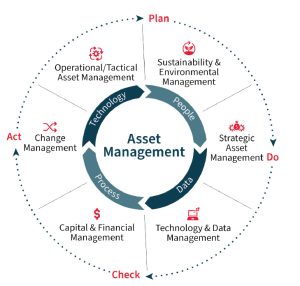
A framework for integrating people, process, technology, and data within asset management.
The Maintenance Gap: Execution vs Insight
What follows is not a gap in planning or condition visibility, but a gap in execution and feedback. If assets are to be managed through their lifecycle, maintenance must do more than keep them running. It must generate the information needed to understand how those assets are performing, how they are changing over time, and what that means for future decisions.
Where It Starts: Data at the Point of Execution
The quality of maintenance data begins at the point of execution, where technicians and operators complete work under real conditions. Work orders are opened, tasks are performed, parts are used, and issues are encountered.
However, the information captured at this stage is often inconsistent. Failure modes may not be recorded, corrective work may be grouped or reclassified, and notes may lack the detail needed to support future analysis. This is not a reflection of effort, but of competing priorities. The focus is, understandably, on restoring service first.
The Breakdown: Fragmented and Misaligned Data
From there, the challenge continues. Even when data is captured, it is not always validated, structured, or aligned in a way that supports broader use. Work order classifications vary, asset hierarchies are not consistently applied, and linkages between maintenance activity, asset records, financial data, and parts usage are often incomplete. As a result, valuable information exists, but it remains fragmented. Without these connections, it becomes difficult to build a coherent picture of asset behavior over time.
This has direct implications for how assets are managed. Without reliable, structured maintenance data, organizations are limited in their ability to understand trends in failure frequency, changes in maintenance effort, or the true cost of sustaining assets. Decisions around rehabilitation, restoration, or replacement continue to rely heavily on condition and age, while the operational reality of those assets remains underrepresented.
Understanding Risk Through Maintenance Data
At its core, asset management decisions come down to risk, typically defined through the relationship between likelihood, consequence, and frequency of failure. Maintenance data plays a central role in this understanding.
Failure history, repeat work, and trends in corrective activity provide direct insight into both likelihood and frequency. When combined with consequence—often defined through service impact, safety, or cost—organizations begin to form a more complete picture of risk, grounded in how assets are actually performing rather than how they are expected to perform.
From Insight to Planning: Budget and Resource Alignment
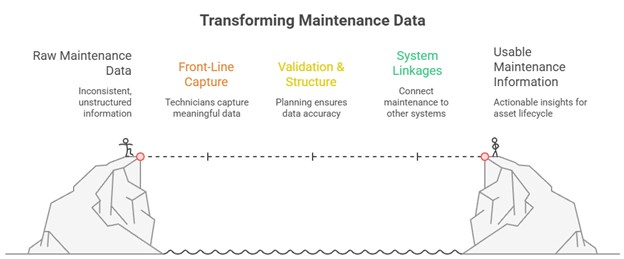
The organizational journey from raw data to actionable maintenance information.
Maintenance data also plays a critical role in improving budget forecasting and resource planning. When organizations understand not just the condition of their assets, but the effort required to sustain them, they gain a clearer view of future demand.
Trends in corrective work, labour hours, and parts usage begin to show whether assets are stabilizing or becoming more resource-intensive over time. This allows teams to move beyond static, condition-based forecasts and begin aligning operating budgets and staffing levels with actual asset behavior. Instead of reacting to unexpected workload spikes, organizations can anticipate where maintenance demand will increase, where specialized skills may be required, and where intervention strategies should shift.
Closing the Gap: What Needs to Change
Closing this gap requires a shift in how maintenance is viewed and supported. Maintenance is not just an operational function; it is the primary source of truth for how assets perform over time. To realize this, a few key elements need to be in place. At the front line, technicians must be supported with clear and practical ways to capture meaningful information as part of the work process. This includes consistent failure coding, structured work order completion, and sufficient context to make that data useful beyond the immediate task.
Beyond capture, there must be validation and structure. Planning and supervisory roles play a critical part in ensuring work is properly classified, assets are correctly assigned, and information is complete before it becomes part of the permanent record. This step transforms raw data into usable information.
Equally important are the linkages across systems and functions. Maintenance data must connect to asset hierarchies, financial systems, and parts inventories to provide full visibility into cost, effort, and performance. When these connections are in place, organizations can begin to see not just what work was done, but what it means in the context of the asset lifecycle.
From Data to Decisions: A Dynamic View of Asset Performance
With this foundation, a more complete and dynamic view of asset performance begins to emerge. Condition data provides a snapshot of state. Maintenance data provides insight into behavior. Operating context adds the conditions under which assets are performing. Together, these elements move organizations toward a more predictive understanding of asset performance—where trends in failures, increasing maintenance effort, and changing operating conditions can be used to anticipate future needs.
This is where decisions begin to change. Instead of relying solely on planned timelines or condition ratings, organizations can begin to adjust strategies based on observed performance. Maintenance strategies can be refined to extend asset life where appropriate, or accelerated interventions can be justified where risk is increasing. Budget forecasts and resource plans become more aligned with actual demand. Capital decisions become more defensible because they are grounded in both condition and performance history.
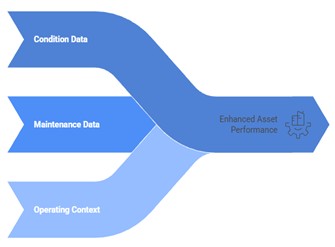
Integrating asset data to improve performance and decision-making.
Managing assets through their lifecycle requires this continuous feedback. Plans define expectations, but maintenance determines outcomes. When the connection between the two is weak, the plan becomes static. When the connection is strong, the plan evolves with the asset.
This is the shift from having a plan to actively managing asset performance over time.
Condition assessments have made it easier to see. Maintenance makes it possible to understand. Together, they allow organizations to sustain performance, manage risk, and make decisions with confidence.
If you’re exploring how to better connect maintenance data to asset performance and lifecycle decisions, connect with me. I’d be glad to share what we’re seeing across the industry.
Social Media: Are you a maintenance organization making the move to continuous improvement in #assetmanagement? Read @Jay Fitzpatrick’s new blog to learn how to build and sustain your asset management plans: LINK.