
Thought Leadership
The Need for Speed: How Ultrafast Environmental Models Help Environmental Planners Make Better Decisions
July 15, 2026
By Ed Gross, Vice President/Lead Scientist and Rusty Holleman, Senior Water Resources Specialist
Are you faced with making decisions based on uncertain information from environmental modeling studies? If so, consider a novel approach to help you gain confidence in water quality and ecological model predictions.
Poorly calibrated environmental models drive flawed decisions. Traditional model calibration relies heavily on professional judgment and manual adjustment of inputs. This process can lead to overly complex and poorly constrained models that get the right answer for the wrong reasons.
There is a better way. Keep reading to learn about a novel approach to simulate environmental processes objectively and that can
- determine optimal model parameters
- identify exactly how much model complexity can be supported by available observational data, and
- rigorously quantify uncertainty.
This faster and better model calibration approach significantly improves confidence in predicting effects of management actions.
The Trap: “The Right Answer for the Wrong Reason”
Predicting environmental concentrations of chemical and ecological constituents is a complex challenge. Many models solve the physical movement of water and transformations simultaneously. These tightly coupled models can take days to run a single simulation, limiting a modeler’s ability to calibrate them.
Because we cannot practically run tens of thousands of simulations to test every possible combination of input variables, modelers are forced to manually tweak a handful of unknown parameters until the model’s output adequately matches field observations.
This creates a massive blind spot. When a model has several poorly constrained inputs, multiple combinations can mathematically cancel each other out to produce a “calibrated” result. A model can look calibrated even when its internal mechanics are entirely wrong. If you use that model to test a costly new management action, its predictions may lead to poor decisions.
The Solution: Fast Simulations via Tracer-Based Models
The goal is to run models faster so there will be less guessing at calibration parameters and, instead, objectively quantify parameters and their uncertainty. This can be achieved through a paradigm shift called tracer-based modeling.
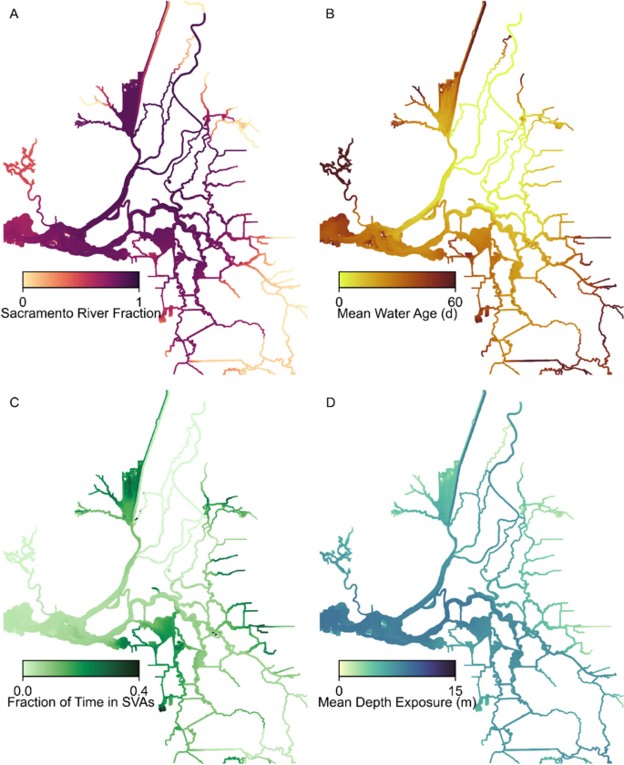
With tracer-based modeling, modelers decouple physical transport and chemical transformations instead of simulating them together. Then modelers use a computationally heavy 3D hydrodynamic model for a single run to track numerical “tracers.” This extracts simple metrics of transport, such as the mean “age” of the water, the time spent in specific regions, and the average water depth. All of this physics data is then fed into a lightweight, decoupled water quality model.
Case Study: Tracking Nitrogen in the Delta
A recent study successfully demonstrated the power of this decoupled approach to estimate biogeochemical rates.
- The study focused on modeling nitrogen cycling in the Sacramento-San Joaquin Delta.
- Previous coupled hydrodynamic-biogeochemical models took weeks to predict nutrient concentrations over a single year. This barrier was overcome by decoupling the transport processes from the transformation processes using age tracers.
- A three-dimensional hydrodynamic model generated a set of tracer concentration fields including tracer concentration and age.
- Tracer information was extracted from the hydrodynamic model run at the times and locations where observations were available.
- A Lagrangian biogeochemical model performed each simulation of nitrate and ammonium concentrations in mere milliseconds on a standard laptop computer using this extracted data.
- This extreme computational efficiency allowed the team to use optimization algorithms to fit unknown transformation rate parameters against observational data.
- The resulting model suggested that dissolved inorganic nitrogen (DIN) losses occurred primarily in shallow vegetated areas.
- Previous nitrogen cycling modeling studies achieved good calibration despite neglecting processes associated with shallow vegetated areas (e.g., uptake by plants). In short, these previous models matched observations partially for the wrong reasons.
- See this article for more information.
Let the Data Drive: Objective Calibration
Manual tweaking becomes obsolete when a model runs in milliseconds rather than weeks by using robust global optimization algorithms that run tens of thousands of biological simulations in a matter of minutes.
This fast approach also solves two critical challenges:
- Right-Sizing Model Complexity: More complex models are not always better. Often, observational data simply cannot distinguish between two overlapping processes. The optimization algorithm demonstrates that the rates are unidentifiable if the data cannot support estimating individual rates. In some cases, the representation can be simplified to estimate the net effect of those processes with confidence.
- Quantifying Uncertainty: Thousands of iterations can be run to map out confidence intervals because tracer-based models are so fast. Instead of presenting a single “calibrated” model run as the absolute truth, decision-makers can now access a rigorously quantified range of uncertainty.
Generality
The approach is widely applicable to surface water, groundwater, and atmospheric modeling. Many modeling studies that involve both transport and transformation processes can be performed in this framework. The accuracy of the blazing fast tracer-based model for any analysis can be verified by inserting parameters derived by this approach back into the original “brute force” coupled model.
The Bottom Line
You cannot manage what you cannot accurately model. This high-speed, tracer-based modeling removes the guesswork from calibration and delivers objective, data-driven, and highly transparent insights that drive confident decisions by regulators and stakeholders.
Want to learn more about tracer-based modeling and how it might apply to your water resources project, contact us at EGross@geiconsultants.com and CHolleman@geiconsultants.com.