
GEI provides comprehensive levee services that support planning, design, regulatory compliance, and long-term risk management to help levee owners keep their system aligned with national program standards and regulations.
GEI delivers levee services for federal, state, and local clients across the full levee life cycle. Our multidisciplinary teams support levee owners, communities, and portfolio managers through technical, regulatory, and programmatic challenges using practical, defensible approaches.
Click image to watch #TeamGEI’s Levee Services video.
We focus on “right-sized and scaled” solutions—balancing life safety, performance, cost, and long-term system resilience based on the type and magnitude of each decision. Our levee services address system evaluation, risk management, regulatory support, and ongoing program needs. Every GEI levee service can be tailored to individual projects or comprehensive levee programs. GEI emphasizes clear communication, defensible analyses, and actionable outcomes that help clients move forward with confidence.
Traditional Levee Life Cycle Services (Permitting, Investigation, Planning, Design, and Construction Support)
More than 6,000 levee systems across the United States help manage flood risk for over 23 million people living in flood-prone areas, forming a critical component of the nation’s flood control system. Rehabilitating, modifying, or constructing levees requires a coordinated life-cycle management approach that considers regulatory requirements, technical performance, constructability, and long-term operations.
GEI’s levee experts support levee owners across the full life cycle—from early permitting and investigations through design and construction engineering support. Our multidisciplinary teams include permit specialists, geotechnical engineers, geologists, structural engineers, hydraulic and hydrologic engineers, civil engineers, cost estimators, and construction QA/QC specialists.
Our holistic approach integrates construction and operations and maintenance (O&M) considerations early in planning and design, helping clients avoid downstream challenges and make informed decisions throughout project delivery.
Our team brings strength in:
• Navigating federal, state, and local permitting requirements for levee projects
• USACE programs and approvals, including Sections 408 and 404/10, Public Law 84-99, Floodplain Management Services, Public Assistance to States, Silver Jackets, and the USACE planning process
• Applying USACE tools and risk-informed approaches to support defensible decision making
• Multidisciplinary collaboration across planning, design, construction, and O&M
Levee Inspections
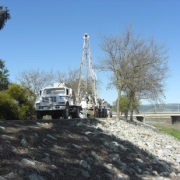
Levee inspections are a critical first line of defense for levee owners; they provide actionable information to support regulatory compliance, public communication, and infrastructure investment decisions. Regular inspections help identify system deficiencies, support maintenance planning, and inform funding strategies.
GEI’s integrated team of engineers and specialists performs comprehensive inspections of levee systems. Our experts are familiar with the USACE Levee Inspection System and the National Levee Database and can conduct inspections ranging from emergency and compliance inspections to routine condition assessments and site visits supporting levee risk assessments.
We:
• Perform all types of levee inspections, including emergency, routine, periodic, formal, and compliance-based inspections
• Provide expertise in USACE Levee Safety Program requirements and software, including the Levee Inspection System and National Levee Database
• Assist levee owners in using inspection results to support asset management and maintenance programs
Levee Risk Assessments
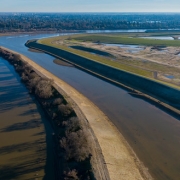
Making informed, cost-effective decisions about levees can be challenging, particularly when resources are limited. Levee risk assessments provide a structured, defensible way for owners to prioritize actions and manage or reduce the risks associated with living and working behind levee systems.
GEI’s levee experts bring a comprehensive understanding of levee safety principles, risk assessment methodologies, and regulatory requirements. We support levee owners in applying risk information within practical decision-making frameworks that align with project goals, regulatory expectations, and available resources.
Our differentiators include:
• Experience across the full spectrum of levee risk assessments, including qualitative, screening-level, NFIP, Levee Review, semi-quantitative, quantitative, and assessments supporting risk-informed design
• Expertise in USACE, FEMA, FERC, and Bureau of Reclamation risk assessment processes and regulatory requirements
• Proficiency with the USACE Levee Screening Tool (LST), Total Risk software, and USACE Risk Management Center (RMC) tools and resources
• USACE training and certifications supporting higher-confidence decision making where greater accuracy and reduced uncertainty are required
• A collaborative, owner-focused approach that aligns the level of analysis with the type and magnitude of the decision
Risk-Informed Design and Decision Making
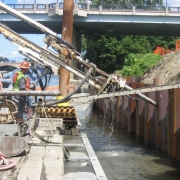
GEI applies risk-informed design and decision making to help levee owners and stakeholders make sound choices under uncertainty—particularly when traditional deterministic approaches are insufficient.
Our work integrates engineering analysis, risk assessment, and structured decision frameworks to support levee and flood risk management projects across planning, design, and operational phases.
Our services include:
• Facilitating and leading risk assessments
• Developing and evaluating risk scenarios
• Quantifying likelihoods and consequences, where appropriate
• Translating technical findings into clear, decision-relevant insights
Facilitation is a core strength of our approach. We bring technical teams, regulators, and decision makers together around a shared understanding of risk, tradeoffs, and risk tolerability. Rather than treating risk as an abstract output, we use it as a tool to prioritize actions, evaluate alternatives, and support transparent, defensible decisions that balance safety, performance, cost, and uncertainty.
National Flood Insurance Program (NFIP) Accreditation
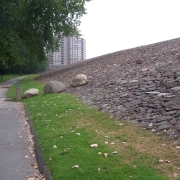
GEI helps levee sponsors and communities navigate the NFIP accreditation process with clarity and confidence. We provide comprehensive technical and strategic support to demonstrate compliance with 44 CFR 65.10 while managing cost, schedule, and regulatory risk.
Our approach goes beyond document production. We help sponsors understand the condition of their system, FEMA expectations, and the most efficient path forward.
Our support includes:
• Evaluating existing data and identifying gaps
• Supporting engineering analyses and inspections
• Coordinating with FEMA and state partners
• Preparing defensible submittals that align with both regulatory requirements and local objectives
We also assist communities facing expiring provisional accreditation, system modifications, or evolving FEMA guidance. Where appropriate, we integrate risk-based concepts to help sponsors understand and communicate residual risk to decision makers and the public, supporting long-term flood risk management.
Portfolio Management Support Activities
More than 35 percent of levee owners in the United States own and operate multiple levee systems. Managing these assets effectively requires a portfolio-based approach to prioritize operations, maintenance, inspections, rehabilitation, and capital investment.
GEI assists levee owners with portfolio-level planning and decision making by:
• Developing asset or portfolio management frameworks and strategies
• Identifying and supplementing existing levee data sources
• Identifying federal programs that support levee systems and assisting with application and evaluation processes
• Establishing governance structures for managing levee portfolios
• Prioritizing levee activities and resources using decision-making frameworks that may incorporate risk
• Supporting compliance with USACE Levee Safety Program requirements, Section 408, FEMA NFIP requirements, state levee safety programs, and state hazard mitigation plans
Levee Owner Support Activities
While levee owner responsibilities vary by geography, regulatory framework, and system characteristics, all owners share a fundamental responsibility: effective operation and maintenance of their levee systems to protect communities.
GEI’s multidisciplinary teams support levee owners by collecting and assessing data, preparing key documentation, training staff, assisting with public outreach, and meeting USACE and FEMA program requirements.
Our support includes:
• Developing Emergency Action Plans (EAPs), O&M manuals, inundation maps, and levee rehabilitation or repair cost estimates
• Training staff on routine levee O&M, emergency preparedness, and emergency response
• Communicating the benefits and value of levee systems to communities and stakeholders
• Applying industry tools, guidance, and best practices to support compliant, effective levee operations