
GEI provides surface water modeling and systems analysis services that help clients understand complex hydrologic, hydraulic, and operational processes to support planning, design, regulatory compliance, and real-time decision-making.
GEI delivers surface water modeling and systems analysis for federal, state, and local agencies; utilities; and resource managers addressing complex water resources and infrastructure challenges. Our teams combine advanced numerical modeling with practical engineering judgment to evaluate how natural and managed systems behave under existing conditions and future scenarios.
Our modeling work supports decisions across the full project life cycle—from planning and permitting to design, operations, emergency response, and long-term program management. We focus on defensible, fit-for-purpose analyses that balance technical rigor with clarity, helping clients understand system behavior, tradeoffs, and risk in a way that supports confident action.
Hydrologic and Watershed Modeling
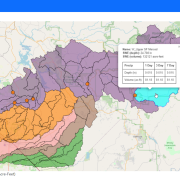
GEI applies hydrologic modeling to evaluate how water enters surface water systems under a wide range of conditions. Our work supports flood risk management, water supply planning, reservoir operations, and climate resilience efforts.
We develop event-based and continuous hydrologic models that incorporate rainfall, snowmelt, watershed characteristics, and climate variability. These analyses are commonly used to support flood-frequency studies, inflow forecasting, system capacity evaluations, and long-term planning.
Our hydrologic modeling services include:
• Rainfall–runoff and watershed-scale modeling
• Flood hydrology and extreme event analysis
• Climate-informed hydrology and scenario evaluation
• Statistical analysis of hydrologic data
• Inflow forecasting to support reservoir and system operations
Hydraulic and Floodplain Modeling
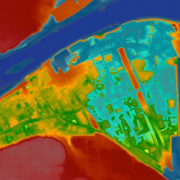
GEI provides hydraulic modeling to evaluate how water moves through rivers, floodplains, channels, levee systems, and hydraulic structures. Our analyses support infrastructure design, floodplain mapping, levee safety, and emergency preparedness.
We perform one-, two-, and three-dimensional hydraulic modeling to assess water surface elevations, velocities, forces, and inundation extents under steady and unsteady flow conditions. These studies are routinely applied to natural and engineered systems, including rivers, flood control facilities, spillways, gates, and conveyance networks.
Our team supports:
• Riverine and floodplain hydraulics
• Levee system performance and breach analysis
• Tidal and backwater effects
• Flood inundation mapping and consequence evaluation
• Hydraulic design and assessment of complex structures
Surface Water Systems and Operations Modeling
GEI specializes in modeling managed surface water systems where operational decisions drive outcomes. Our systems modeling evaluates how reservoirs, channels, gates, and interconnected infrastructure perform under competing objectives and changing conditions.
We support single- and multi-reservoir systems, integrating hydrology, hydraulics, and operational rules to evaluate water supply reliability, flood risk, environmental flows, and hydropower considerations. Our analyses are used for planning, optimization, and real-time decision support, including forecast-informed operations.
Services include:
• Reservoir and system operations modeling
• Evaluation of operating rules and alternatives
• Tradeoff analysis across flood, supply, and environmental objectives
• Scenario testing under climate variability and change
• Support for emergency response and adaptive operations
Water Quality, Transport, and Environmental Processes
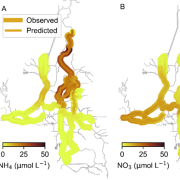
GEI applies numerical modeling to evaluate water quality and transport processes that influence regulatory compliance, ecosystem function, and system performance. Our work integrates hydrodynamics with constituent transport to understand how physical and chemical conditions evolve over time and space.
We model temperature, salinity, sediment transport, nutrients, and other constituents in rivers, reservoirs, estuaries, tidal marshes, and coastal systems. These analyses support environmental review, restoration planning, operational decision-making, and long-term impact assessment.
Areas of application include:
• Temperature and water quality modeling
• Salinity intrusion and estuarine dynamics
• Sediment transport and fate
• Coupled hydrodynamic and water quality systems
• Evaluation of restoration and infrastructure impacts
Advanced Numerical Modeling and Uncertainty Analysis
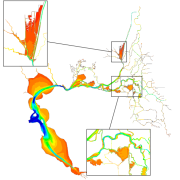
GEI brings advanced numerical modeling expertise to complex surface water problems where traditional approaches may be insufficient. Our team applies a range of numerical methods to represent physical processes, evaluate system behavior, and support decisions under uncertainty.
We develop and apply one-, two-, and three-dimensional models using finite difference, finite element, and finite volume techniques. Where appropriate, we incorporate ensemble modeling, sensitivity analysis, and uncertainty evaluation to help clients understand the range of possible outcomes and associated risks.
These capabilities are applied to:
• Complex river–reservoir and estuarine systems
• Long-term scenario and stress testing
• Evaluation of rare or extreme events
• Risk-informed planning and design decisions
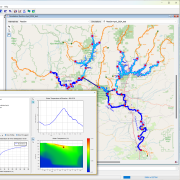
Model Development, Calibration, and Decision Support
GEI supports the full modeling lifecycle, from development and calibration through application and communication of results. We place strong emphasis on model credibility, transparency, and documentation to ensure analyses are defensible and fit for regulatory, planning, and operational use.
Our teams routinely work with federal and state agencies, stakeholders, and partner firms to support multidisciplinary studies and decision-making processes.
We assist clients by:
• Developing, calibrating, and validating numerical models
• Performing peer review and independent technical review
• Preparing documentation for regulatory and stakeholder review
• Translating modeling results into clear, decision-relevant insight supporting transition of models to client ownership and use