

Thought Leadership
Headline: Practical AI in Maintenance — What AI Can (And Should) Do Today
November 23, 2026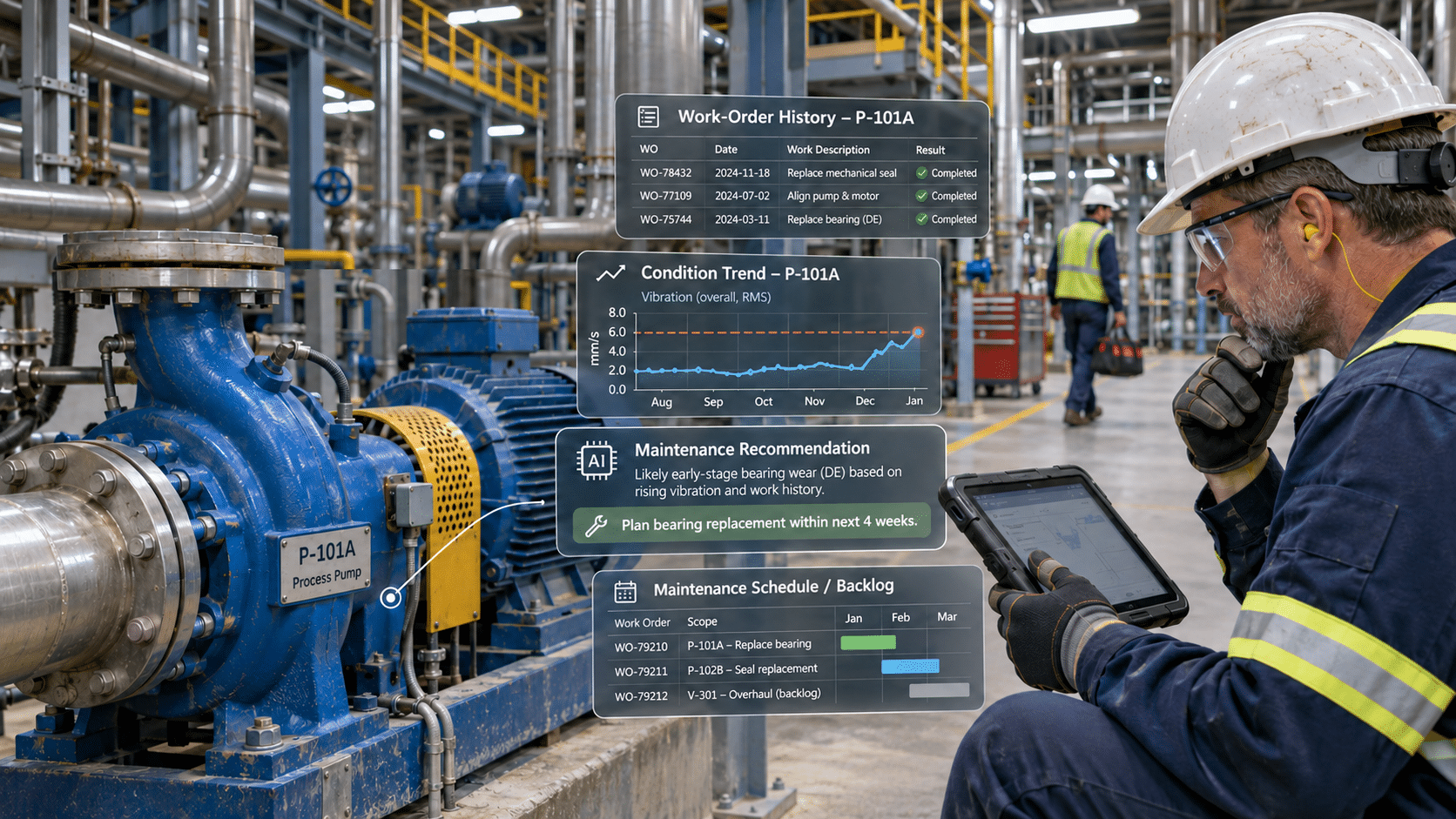
What AI can do, what it should do, and what it does are not necessarily the same.
Example: Another mechanical seal fails on a pump. It’s the fourth replacement in eighteen months. The work orders are closed, the repair notes are in the CMMS, and the maintenance team is dealing with the same problem. Again.
Now imagine asking an AI assistant why the seals keep failing. Within seconds, the assistant reviews the available equipment history, identifies patterns, and provides a convincing explanation. Is that a diagnosis, or a well-written guess based on similar stories, case studies, or incomplete information?
Artificial intelligence has advanced significantly throughout 2026, with capabilities extending beyond information analysis into maintenance planning, troubleshooting, and connected work management systems. But three distinctions matter: what AI can do, what it should do, and what maintenance organizations are actually doing with it.
What AI Can Do
AI can process large amounts of information that maintenance teams often struggle to access or use consistently. It can search technical manuals, summarize equipment histories, identify similar work orders, assist with maintenance planning, and use operating data to identify abnormal conditions or potential risks.
More recently, AI agents have begun supporting activities within Computerized Maintenance Management Systems (CMMS) and Enterprise Asset Management (EAM) systems. These capabilities can gather equipment information, evaluate scheduling constraints, prepare work plans, and support maintenance workflows. Software vendors are increasingly integrating these capabilities into their platforms.
But finding information in a manual, predicting a potential equipment failure, and developing a maintenance schedule are different applications. Each requires different information, technical capabilities, and levels of validation.
Understanding those differences is essential when deciding where AI can be useful.
What AI Is Actually Doing
AI gets a lot of attention for predicting failures. But its most immediate applications are far less complicated. Consider how much time maintenance departments spend locating drawings, reviewing previous repairs, interpreting incomplete work orders, or preparing job plans from information scattered across multiple systems.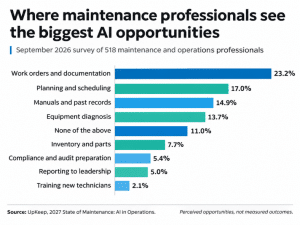
A 2026 survey of maintenance and operations professionals found that respondents identified considerable opportunities for AI in documentation, planning, and information retrieval. Equipment diagnosis ranked below several of these activities. While these findings reflect perceived opportunities rather than proven results, they highlight where maintenance teams see value.
In one published implementation, an industrial maintenance services provider used AI to convert more than 1,500 spreadsheet-based preventive maintenance instructions into structured job plans. The company reported a 65% reduction in manual data extraction and preparation effort. That doesn’t demonstrate improved equipment reliability, but it does show AI’s potential to reduce maintenance work.
AI may also improve how organizations capture and interpret maintenance information. Better reporting can make previously overlooked failures, minor stops, and corrective activities visible, causing recorded downtime to increase even when equipment performance has not deteriorated.
Sometimes better technology gives us a more accurate picture of the problems we already have.
The Difference Between Selling AI and Delivering Results
Software providers are rapidly expanding the AI capabilities available within maintenance management platforms. Solutions from companies such as IBM, SAP, MaintainX, and others offer AI-assisted work management, predictive monitoring, troubleshooting support, and increasingly connected workflows. These products address legitimate maintenance challenges, and some implementations demonstrate measurable benefits. There is, however, a distinction between what a product is designed to accomplish and what an organization can achieve with it.
An AI-generated job plan may still require technical review and confirmation of the equipment requirements. A predictive warning must be evaluated before determining the appropriate intervention. An optimized schedule is only useful if its underlying assumptions reflect actual operating constraints. Organizations also need to consider the additional licensing, integration, training, and process changes that may accompany these capabilities. These are not necessarily shortcomings of the software but factors that influence whether the investment delivers results. A demonstration can show what a product can do; organizations still need the processes required to benefit from it.
What AI Should Do
Return to the pump experiencing repeated mechanical seal failures. AI might identify recurring failures under particular operating conditions, similar repair descriptions recorded under different work-order codes, or corrective actions that repeatedly addressed symptoms without resolving the underlying problem. That information could provide a better starting point for investigation. Repeated seal failures do not necessarily mean the seals are the cause. Improper installation, contamination, operating conditions, or other system issues may be contributing. An experienced maintenance or reliability professional still needs to evaluate the possibilities against operating conditions, equipment history, and physical evidence. This is also where data quality becomes important.
Organizations do not necessarily need perfect maintenance records to benefit from AI. An assistant searching approved technical manuals has different data requirements from a predictive model estimating equipment failure risk. AI can help identify inconsistent or missing information, but its findings must reflect the quality of the available data. Research demonstrates that combining AI with structured engineering knowledge and verification processes can reduce unsupported technical conclusions. The opportunity is to use AI to bring relevant information together, support technical judgment, and help determine the most appropriate maintenance intervention.
AI should improve the quality of maintenance decisions, not simply increase the number of recommendations generated.
The Work Still Needs to Get Done
One challenge that advances in AI have not eliminated is the lack of skilled maintenance personnel.
AI may help develop hundreds of preventive maintenance tasks, but completing them still requires qualified personnel, available labour hours, materials, equipment access, and coordination. Not every newly identified task should automatically become scheduled work, either. Maintenance activities must still be evaluated for their technical justification, risk reduction, and resource requirements.
Workforce availability remains a significant challenge. A 2026 industry survey of maintenance leaders found that 37% described their teams as chronically understaffed, with difficulty finding qualified candidates remaining a major concern. AI can make existing personnel more effective by reducing administrative effort, improving access to technical knowledge, and helping redirect resources. It does not, however, create additional qualified tradespeople or capacity.
For organizations already struggling to complete preventive maintenance, identifying more requirements could increase the backlog.
AI should help prioritize which activities are necessary, provide the greatest benefit, and make the best use of existing resources.
The objective should not be to generate more maintenance work. It should be to identify and complete the right work with the resources available.
A Question for Your Maintenance Team
AI is improving how we access information, identify equipment problems, and develop maintenance strategies. The challenges of limited resources, competing priorities, and having enough skilled personnel to complete the work haven’t disappeared.
As these technologies become more accessible, the key opportunity is to improve the work we’re already doing, not simply create more of it.
If AI could identify every maintenance issue in your facility tomorrow, would your organization have the resources, processes, and capacity to do anything about it?
If you’re looking to explore your objectives and the maintenance insight AI should provide your organization, let’s connect. Email me at JFitzpatrick@geiconsultants.com.