

Thought Leadership
The Water Is Clean – Where Did the PFAS Go? Why the Future of PFAS Engineering Depends on Lifecycle Management, Not Just Treatment
August 27, 2026
Every successful PFAS treatment system solves one problem while creating another.
When water passes through granular activated carbon (GAC), ion exchange (IX), reverse osmosis (RO), or other treatment technologies, PFAS is removed from the water, but it is not eliminated. Instead, it is concentrated into spent media, brine, foamate, sludge, or other residuals that require long-term management. As utilities move from implementing PFAS treatment systems to operating them over decades, that distinction is becoming one of the defining challenges in PFAS engineering.
For the past decade, PFAS engineering has focused on removing contaminants from water. Today, the engineering conversation is evolving. The critical question is no longer simply how to remove PFAS from water, but how to manage and ultimately destroy the concentrated residuals that treatment inevitably produces.
Conventional PFAS treatment transfers contaminants from water into a smaller, more concentrated waste stream that must be regenerated, destroyed, or disposed of. As a result, treatment performance alone is no longer sufficient to define project success. Engineers must also consider residual management, lifecycle cost, operational flexibility, and the ability to incorporate future destruction technologies as they mature. For utilities planning, designing, or operating PFAS treatment systems, this shift has important implications for long-term project performance. The following discussion explores the PFAS Lifecycle framework, the engineering considerations it introduces, and why lifecycle thinking is becoming an essential part of treatment planning and design.
PFAS treatment is no longer simply a water treatment problem. It is a lifecycle management challenge.
From Treatment Selection to Lifecycle Management
The PFAS Lifecycle provides a practical framework for understanding how treatment decisions influence long-term project performance.
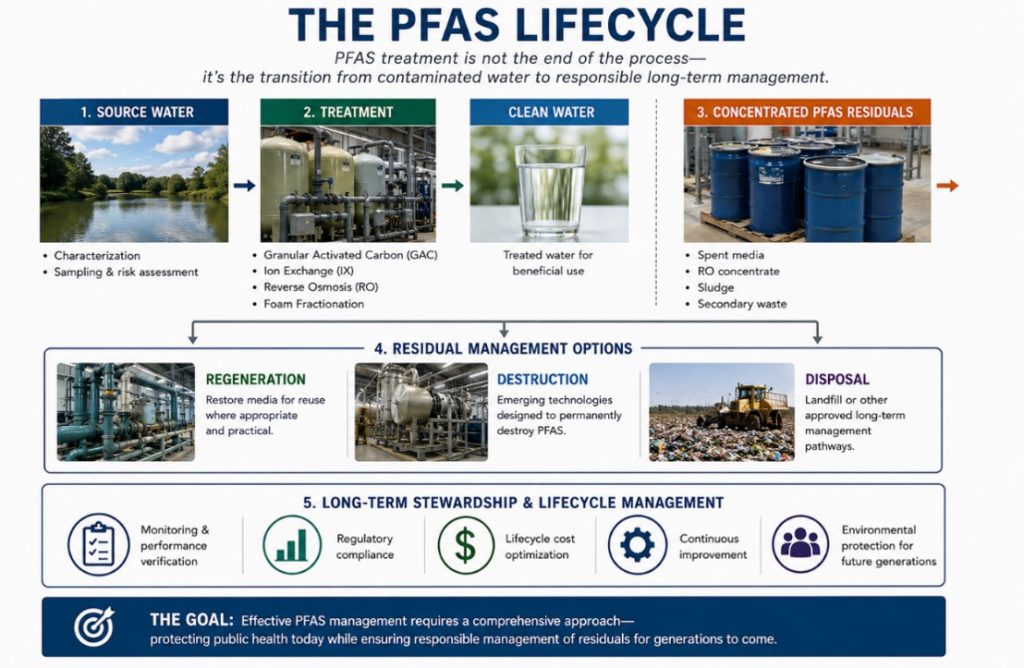
Within this framework, treatment technology influences far more than removal efficiency. It determines residual generation, lifecycle costs, operational flexibility, and future management options. Treatment systems must therefore be evaluated not only by the quality of the water they produce today, but also by how effectively they support responsible residual management over decades of operation.
Lifecycle Thinking in Practice
The transition from treatment selection to lifecycle management is already changing how PFAS projects are planned.
During a recent municipal drinking water planning study, the project initially focused on familiar engineering questions: Which treatment technology would achieve the required PFAS removal? How did granular activated carbon compare with ion exchange in terms of performance, cost, constructability, and operations?
As the evaluation progressed, the conversation shifted. Instead of debating removal efficiency, the client began asking what would happen after treatment. How often would media require replacement? Where could spent media be regenerated or disposed of? How would transportation, residual handling, and future regulatory changes affect long-term operating costs?
The recommended treatment technology ultimately remained the same.
The basis for selecting it did not.
Lifecycle considerations became as important as treatment performance. The preferred alternative was no longer judged solely by its ability to produce compliant water, but by its ability to support a practical, resilient, and sustainable management strategy over the life of the facility.
That experience reflects a broader evolution in PFAS engineering. As utilities invest in infrastructure expected to operate for decades, treatment systems can no longer be evaluated independently of the residual management strategies that support them. Success depends not only on removing PFAS from water, but on responsibly managing the concentrated residuals that treatment creates.
Residual Management and Closing the PFAS Lifecycle
Every PFAS treatment technology produces a concentrated residual that must be managed. Granular activated carbon generates spent carbon, ion exchange produces spent resin or regeneration waste, reverse osmosis creates concentrated reject streams, and foam fractionation generates highly concentrated foamate. These residuals differ in handling requirements, lifecycle costs, and long-term management pathways, making residual management an essential part of treatment selection.
This shift naturally raises the next engineering question: Can concentrated PFAS residuals be permanently destroyed rather than continuously managed?
Emerging technologies including supercritical water oxidation, electrochemical oxidation, plasma treatment, hydrothermal processing, and mechanochemical destruction seek to permanently break the carbon-fluorine bonds that make PFAS so persistent. Although these technologies continue to mature through pilot testing and early commercial deployment, they offer the potential to move beyond long-term containment toward complete lifecycle management.
The engineering challenge is therefore not simply selecting today’s best treatment technology but designing systems that can adapt as destruction technologies mature. The most resilient PFAS strategies will balance treatment performance with lifecycle cost, operational flexibility, responsible residual management, and the potential to ultimately close the PFAS lifecycle.
Designing for an Uncertain Future
Because PFAS regulations, treatment technologies, and residual management practices will continue to evolve, adaptability has become a fundamental design objective. Facilities that can accommodate changes in media replacement, residual handling, pretreatment, and future destruction technologies will be better positioned to respond to changing regulations and emerging technologies. Evaluating lifecycle costs, including transportation, disposal, monitoring, and future compliance helps utilities make more resilient long-term investments.
The Next Evolution of PFAS Engineering
Environmental engineering has always evolved by expanding the definition of the problem. Wastewater treatment progressed from collection to nutrient removal. Air pollution control evolved from emission capture to long-term performance optimization. PFAS is following the same path. The first generation of projects focused on removing contaminants from water. The next generation will focus on managing and ultimately destroying the contaminants that treatment captures. The PFAS Lifecycle provides a practical framework for that transition, reminding us that treatment is not the end of the process but the beginning of long-term stewardship. Ultimately, the success of a PFAS treatment system should be measured not only by the quality of the water leaving the facility, but by how responsibly the contaminants are managed throughout their entire lifecycle.
If your utility is planning or operating PFAS treatment systems, contact me to discuss how lifecycle thinking can strengthen your long-term management strategy.
The water may be clean.
The engineering work isn’t finished.