

Thought Leadership
From Dam Inventory to Action: How Screening-Level Risk Assessments Help States Prioritize Dam Safety
August 3, 2026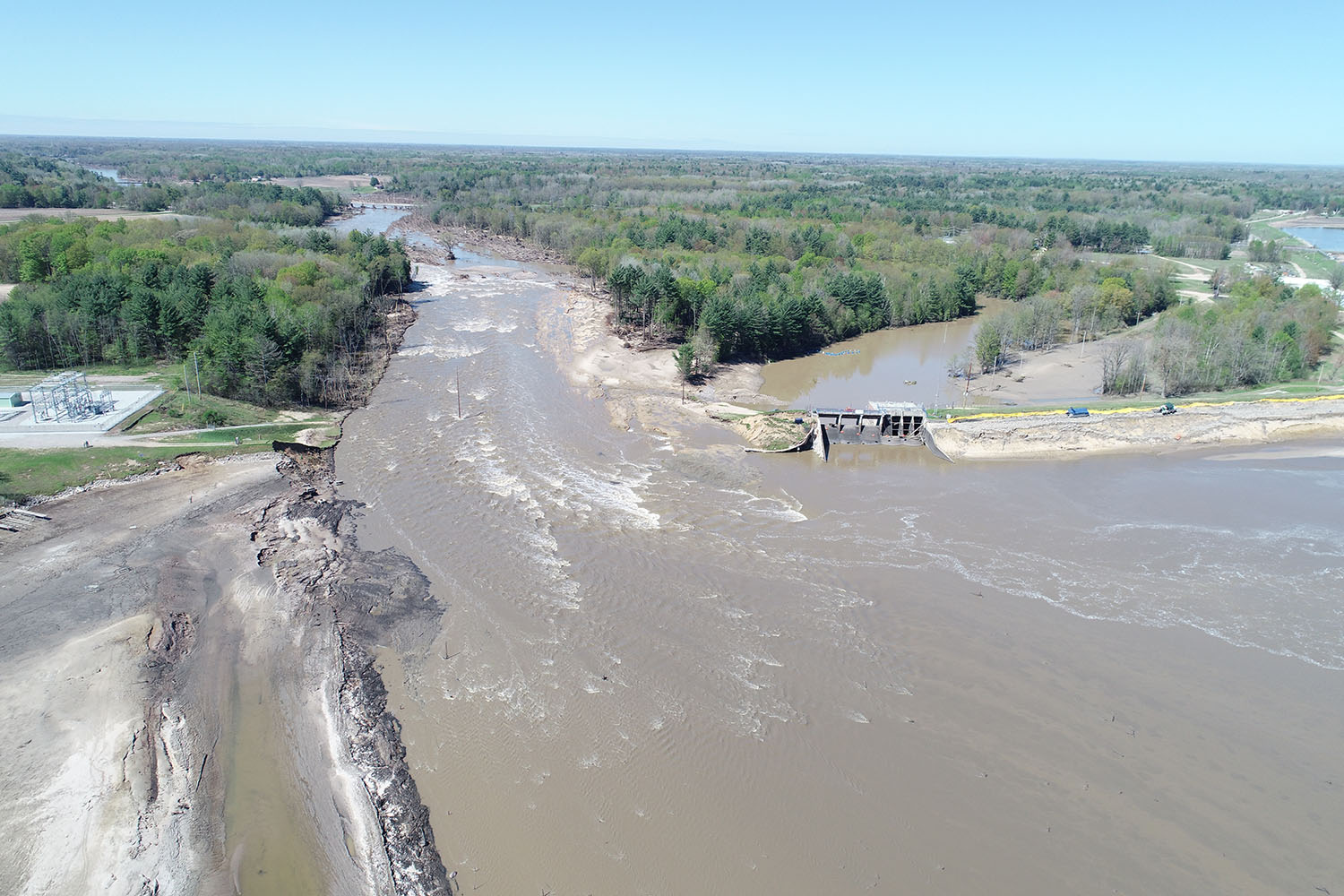
Dam safety program managers are often asked to answer a deceptively simple question: Where should limited time, funding, and technical resources be focused first?
For owners and regulators responsible for many dams, the answer is rarely obvious. Some dams have updated studies and recent inspections. Others have limited documentation, and unknown spillway capacity. Few have dam breach consequence information. Without a consistent way to compare risk across a portfolio of dams, decision-makers can be left relying on incomplete information, one-off studies, or addressing the most immediate issue in front of them.
That is where screening-level risk assessments (SLRA) can help.
Following the 2020 Edenville and Sanford Dam failures, Michigan’s Department of Environment, Great Lakes, and Energy (EGLE) reviewed its Dam Safety Program and developed recommendations to strengthen dam safety statewide, including a recommendation to develop a state-wide risk prioritization process. To support that recommendation, our team conducted an independent screening-level risk prioritization for the 219 high and significant hazard dams under state regulation.
The result was the “Michigan Tool”, a customized framework developed to help evaluate risk consistently across a large dam portfolio. The tool was designed around the foundational pieces of the risk equation as described below:
Risk = P (Failure|Hazard) X P (Hazard) X Consequences|Failure
Where the probability of failure given the hazard is referred to as the System Response Probability (SRP), and the probability of the hazard is often referred to as the likelihood of the load or the Annual Exceedance Probability (AEP) of the load. Lastly, the consequences experienced as a result of the failure, are referred to as “consequences” (or “incremental consequences,” if appropriate).
Using the Tool
The Michigan Tool was built to use available background data, support repeatable documentation, and allow updates as portfolio conditions change. To assess an individual dam’s risk, the team reviewed available dam records to understand the quantity, quality, and type of data available. Critical data gaps included missing recent inspection reports, no spillway rating curve, and no reservoir storage capacity information. Based on the identified data gaps, the 219 dams were grouped into categories based on readiness for risk prioritization. After data review, the risk-ready dams were sent to the SLRA process and missing information was developed for dams that were not risk-ready.
Because consistency is essential in a portfolio-wide effort, Michigan’s process also included structured workshops, standardized presentations, documentation in the tool, recorder training, and subject matter expert training. Each workshop team included a recorder and structural, geotechnical, and hydrologic/hydraulic subject matter experts (SMEs).
The Michigan Tool evaluated common potential failure mechanisms (PFMs) under normal and flood loading conditions. PFMs included slope stability, internal erosion, overtopping erosion, global stability, structural failure, operational or mechanical failure of spillway gates to open, and scour. Seismic loading was determined not to drive dam risk in Michigan. SMEs then used defined influence factors – such as observed conditions, results of record analyses, and historic performance – to support development of consistent system response probability estimates.
The consequence side of the assessment used the USACE Dam Screening Tool (DST) to estimate incremental potential life loss, exposed population at risk (EPAR), and financial damages. Because the portfolio included both significant and high hazard dams, financial damages and exposed population at risk were used alongside potential life loss to help compare dams with different consequence profiles. The results for the portfolio include all dams plotted on three risk plots (life loss, EPAR, and financial damages).
Looking Ahead
For decision-makers, the value of this type of framework is not just the final risk plots. Rather, it is the ability to translate screening-level risk results into defensible actions to reduce risk and focus limited resources. Michigan’s next steps include targeting areas of uncertainty and low confidence, evaluating cost-effective ways to reduce risk, communicating results with dam owners, and defining practical steps for managing their portfolio and updating the risk portfolio. Our team is also developing a dashboard to aggregate study findings, provide visualizations, maps, risk estimates, consequence estimates, and dam risk classifications on a single platform.
For states, dam owners, and policymakers interested in risk-informed decision-making, the lesson is clear: a screening-level approach can provide a practical starting point and risk prioritization does not require perfect information to begin. This approach can help transform available information—whether extensive or limited—into a consistent, comparable, and defensible basis for prioritizing dam safety actions.
If your organization is managing a portfolio of dams and wondering where to begin, contact me to discuss developing a scalable risk-prioritization framework tailored to your data, regulatory environment, and decision-making needs.
_________________________________________________________________________
We recently published an article in The Journal of Dam Safety, published by ASDSO, which discusses the Michigan Project, and we will be presenting more on this work at 2026 ASDSO in Raleigh.
Also at ASDSO, GEI, along with several state dam safety program managers, is presenting a panel discussion on a proposed framework to assist states in using risk-informed decision making to support dam safety decisions. If you’re at ASDSO, come see us.