

Thought Leadership
Designing habitat restoration sites for wildfire risk reduction
August 27, 2025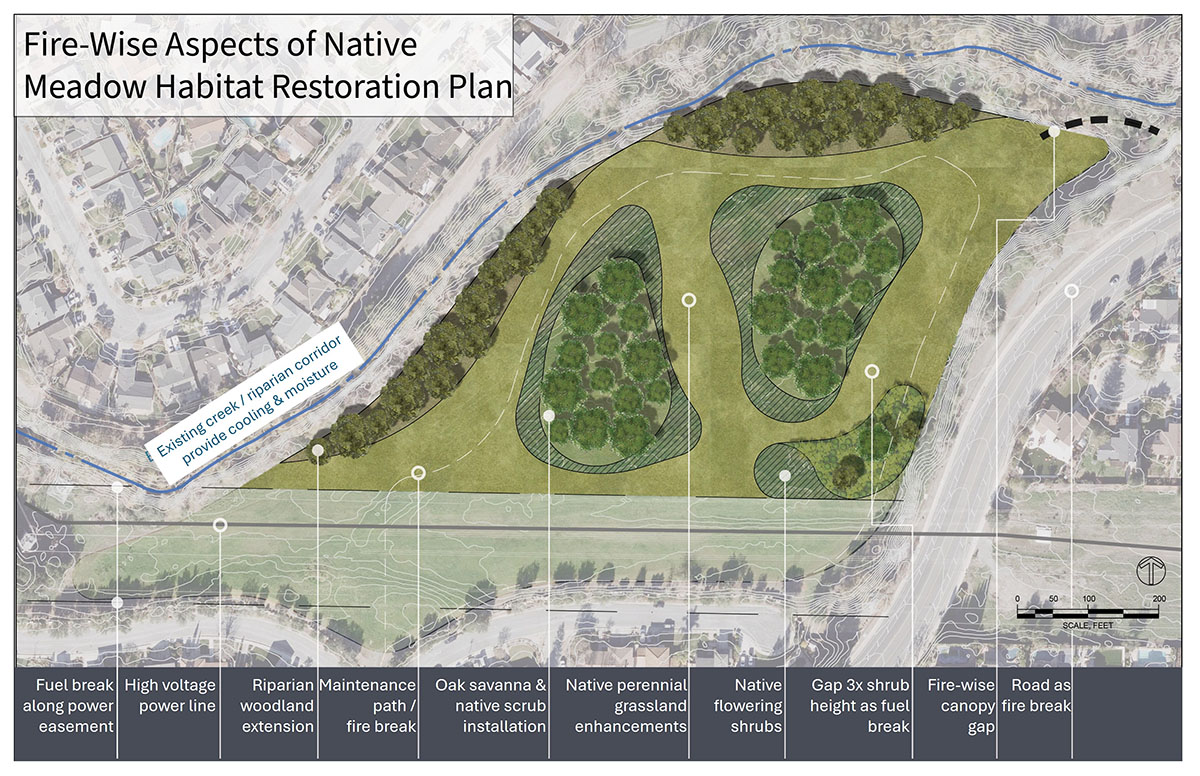
I recently had the privilege of helping design, along with fantastic GEI restoration ecologists Lynn Boyd, Carol Maxwell, and Alicia Beverage, a 13-acre habitat restoration for a water utility client. Our design focused not only on restoring native plants and wildlife-friendly components, but, at the client’s request, on incorporating resilience to future heat, floods, and wildfires. Restoration ecology has traditionally focused on habitat recovery, returning landscapes to some target historical condition. But in a rapidly warming world, with increasingly more destructive weather, the focus of restoration ecology is shifting. Now, in addition to recovery, we must also design to minimize future habitat destruction. As we do this, one of the areas in which I hear the most confusion is: How can we design specifically to reduce wildfire risk?
Fun fact: In my spare time, I volunteer as a wildfire safety ambassador for my local fire department. Because of this, in addition to my professional work in ecosystem climate adaptation, I help my neighbors reduce their home wildfire risk. Touring residential properties at the owner’s request, I recommend landscaping and structural risk improvements. Recently, (because I live in the San Francisco area and this happens here), I responded to a home owned by the CEO of a multinational corporation. I worked mostly with his wife, but invited all adults in the home to join for the first five minutes, as that’s the most important time in my hour. So he joined for my five-minute introduction. Three times during the next hour (really) he popped out to tell us that his mind was blown – blown! – by what he’d learned, and that his entire perception of risk had shifted. It was charming, but also illustrative: wildfire risk reduction is not intuitive. Not even for very smart people whose day job involves constant risk assessment and reduction. Not even for ecologists, until we’re also trained in wildfire behavior.
So let me introduce a few key concepts, which can help anyone improve wildfire resilience into a habitat restoration project. These won’t eliminate fire, but can help to slow and cool wildfire as it moves across a landscape. Why is slowing and cooling the goal, rather than blocking fire access from offsite, or planting fire-resistant or fire-adapted plants? Because no matter what, ignition happens, and with more lightning and denser populations, dryer soils and plants, and hotter days, “fire adapted” plants are not sufficient to maintain post-fire habitat. By slowing and cooling extreme fire behavior, we can help wildlife and larger trees survive, give firefighters time to respond, and reduce deeper soil damage, which supports post-fire habitat recovery.
This is not a complete compendium – just tips which are hopefully helpful, chosen because they are widely applicable. That last bit is critical, because wildfire risk factors are not the same from habitat to habitat. Fire risk and behavior is influenced by fuel type, location and density, wind direction, geography, topology, and the location of likely ignition sources. For any specific restoration plan, each of these factors must be considered.
Below are five common concepts, used in GEI’s fire-smart habitat restoration designs; these concepts can be adapted to most landscapes that we used in the habitat restoration described above.
Plant density and location – not plant species, is the biggest driver of risk. There are no fire-resistant plants. Even wetlands now burn. The West Mims Fire in Georgia burned 152,515 acres of wetlands in the Okeefenokee National Wildlife Refuge. In 2022, more than 3 million acres burned in Alaska. Here in California, fires are both hotter and faster than just a few decades ago. Where a fire took, in the 1960s, more than three days to burn from Napa to Sonoma, a similar ignition in 2017 raced across a near-identical burn footprint in just three hours. These new fires melt heavy steel. No plant species can resist that heat – but thoughtful plant distribution can help. Years of fire suppression have created miles of denser-than-historical forests. When dense growth creates a constant line of fuels with few gaps, flames can race across a habitat without pause. Areas where plants touch or climb without gaps are “fuel ladders,” inviting flames to climb.

Ground fires are significantly less destructive than canopy fires. Ladder fuels, defined as continuous vegetation from the ground to a tree canopy, carry flames into the highest branches. In both natural and residential settings, removing ladder fuels minimizes canopy fire. A reasonable generalization is that plants will burn to three times their own height, so keep understory plants at least that much lower than the lowest tree branches. If designing a mixed-story habitat, consider placing areas of dense mid-story growth outside the dripline of your large trees, rather than close under the trees.
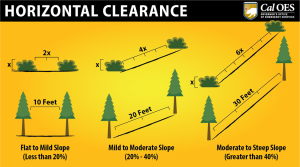
Firebreaks, Fuelbreaks, and Shaded Fuelbreaks slow wildfire and help keep it cooler. Firebreaks are stretches of zero fuel (groundcovers such as stone, gravel, or bare soil), and fuelbreaks are stretches with low fuel content – a low meadow, or sparsely populated plantings. Shaded fuelbreaks are similar to what traditional tribal burning practices created for centuries: forests where the understory plants or ground fuels are sparse or short enough to keep flames from reaching tree canopies, while the canopy holds humidity and cool soils. Breaks within otherwise dense, high quality habitat, creating discontinuous islands, add fire resilience. When a flying ember ignites one island, the break will slow the spread of flames to the next. The image below provides guidance regarding appropriate fuel break spacing. Consider each image of a plant or tree as equal to a group of plantings, and place as needed to meet habitat needs. Paths, ground covers, succulents, or piled rocks and boulders are all appropriate for fire-resistant breaks around each island.
While all plants will burn, some create more risk than others. Understanding those risks is critical. Scientific literature is extremely contradictory regarding native plant species and their tendency to spread fires, but some basic generalizations include:
- Eucalyptus are adept at catching and spreading fire, but intense, regular maintenance can reduce the risk they pose. This National Park Service resource provides more information.
- Cypress and junipers species produce dark, acrid smoke so thick it blocks evacuation routes. Keep native junipers at least 10 feet from roads.
- Fragrant species such as sages are highly flammable, but this does not necessarily translate into spreading flames farther. Studies are ongoing.
- Succulents are less prone to burn due to moisture content, so while they will be killed by fire, they are highly unlikely to spread fire.
- Riparian (river) corridors are generally less prone to burn due to moisture content but will burn in the right conditions. They may provide some protection, and denser habitat may be warranted, depending on your project’s risk parameters.
Prioritize what to protect. Design with variable risk concern. Consider where, within your habitat, fire may damage especially sensitive areas, such as special status plant locations, significant nesting sites, roads, culverts (a melted culvert can lead to later flooding or sinkholes), power lines, and buildings. Maintain these areas with the least fuels or most significant fuel breaks. Roads and power lines are also likely ignition sources, so fuelbreaks adjacent to each may help prevent local ignitions from spreading. Long-term maintenance of these areas should be prioritized.
Would you like more information on wild-fire smart habitat design? Feel free to reach out to me.