

Thought Leadership
California as Ground Zero for North America’s Golden Mussel Invasion: What to know about the Mussel that has Already Triggered a State of Emergency in San Joaquin County
May 4, 2026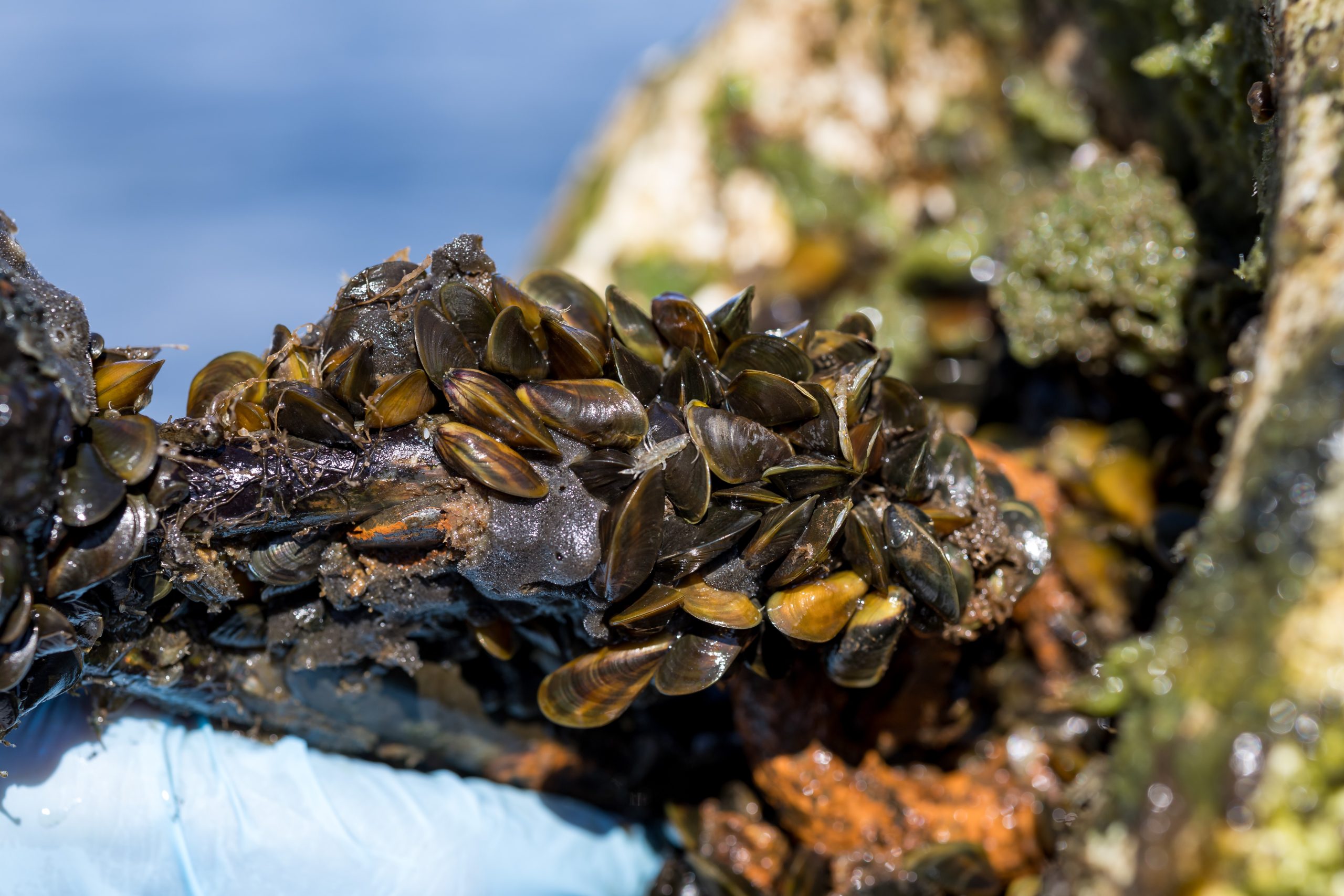
Highly invasive mussels are spreading rapidly through California’s waterways – and the impacts could be devastating. The golden mussel, a native of southeast Asia, was first detected in North America in October of 2024 in California’s Sacramento-San Joaquin Delta. Since then, it has spread nearly to the Mexican border and has rapidly become a top priority for water municipalities and regulators throughout California. Though California’s water owners and managers are accustomed to dealing with invasive zebra and quagga mussels, the golden mussel is (almost literally) blowing both out of the water – beating both species in how fast and far it can expand, and the damage it can cause where it arrives.
Golden mussels first invaded South American waterways in the 1990s, where they have spread at rates of 240 kilometers per year through Argentina to Brazil’s network of surface water and water infrastructure. And, though the economic impacts of the golden mussel on the electrical sector in Brazil alone are estimated to be $120 million per year, no magic solution to the growing golden mussel population has been found.
The South American golden mussel experience foreshadows dire circumstances for California’s waterways. Our engineers and scientists encourage you to tackle the golden mussel issue head-on. I asked GEI’s leading experts, whose careers are filling with golden mussel projects almost as quickly as California’s waterways, to weigh in on how you can manage golden mussels in your own waterways.
How is the golden mussel different from other mussels we encounter in California’s reservoirs and waterways?
Most water agencies and reservoir operators are familiar with quagga and zebra mussels, which have been in California since the early 2000s. The golden mussel is relatively similar to the quagga and zebra mussels, but they can inhabit a wider range of water bodies as they can both survive longer outside of water and tolerate wider ranges of salinity, temperature, and calcium levels. Because of this, some areas that were potentially not impacted by quagga and zebra mussels are now susceptible to the golden mussel invasion. Golden mussels also reproduce more rapidly, grow faster, and have stronger byssal threads allowing them to attach to more substrates and surfaces and withstand higher water velocities compared to other mussels.
– Mark Ashenfelter, Senior Fisheries Biologist
Is the golden mussel an urgent problem?
Yes. The golden mussel is impacting water supply facilities, flow capacities, and deliveries to water customers. The mussel continues to clog essential water facility components, limiting the amount of water that can be delivered and impacting customers who are not receiving their scheduled water. Clients that have been affected so far by the golden mussel invasion are reporting huge increases in operations and maintenance requirements. In addition, in some areas the mussel has attacked essential fire suppression water systems, rendering them inoperable. Those affected are not only considering how to address the problem as quickly and effectively as possible, but also how to fund long-term mitigation measures.
– Rich Sanchez, Senior Vice President
How are California’s water managers and advisors approaching efforts to curb the golden mussel population?
We know that our clients, including state agencies and private water companies, are establishing task forces to coordinate a response. Some are closing reservoirs to boating access or turning off water imports while they assess the threat and develop response plans. Clients have requested vulnerability analyses, management options, cost estimates for remedial measures, and implementation of mitigation measures. We are examining a very long list of exclusion and mitigative measures. A few examples include design and construction of boat inspection stations and chlorination facilities, special coatings to resist mussel attachment, in-line radiation and UV systems to kill mussel larvae as they move through pipes. Each type of environment will need a specific solution; there is not yet a one-size-fits-all answer.
Rich Sanchez, Senior Vice President and Rebecca Verity, Climate Practice Leader
Is the golden mussel more concerning for water quality or infrastructure integrity?
In general, the most critical impact is usually on infrastructure and its implications on operations, water delivery, and treatment. The species is fast-growing, spawns year-round, is tolerant of a wide range of water quality conditions, and creates very dense mats that can quickly block pipes or impair infrastructure. This can result in significant financial implications for agencies and reservoir owners due to impacts on operations. However, this mussel can also have big impacts on water quality, including indirect effects due to clogging of infrastructure related to water treatment processes.
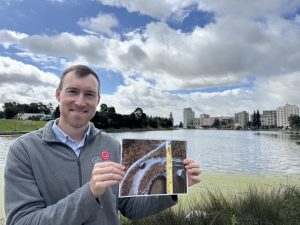
GEI structural engineer, Caleb Stewart, with a photo of a single mussel inside a pumping plant; a harbinger of a coming invasion.
All mussels are filter feeders, which means they pull out algae and particulates, providing a water quality benefit. However, in some cases, these mussels create such dense colonies that they can over-filter the water and reduce food supply for native species, possibly supporting toxic algal blooms. The native species have a natural balance in the ecosystem, and the golden mussel can disrupt this, leading to unforeseen problems. Additionally, in extreme cases, a high density of mussels in confined or shallow areas can actually create dead zones with limited oxygen, causing degradation in water quality due to decaying organic matter.
– Chris Stransky, Senior Aquatic Scientist
How are GEI’s experts responding to this new invasion?
Managing golden mussels requires a multi-disciplinary approach. We’ve assembled engineers, biologists, water quality scientists, and planners to form the GEI Golden Mussel Management Team. We are focusing our water sector existing expertise to identify system vulnerabilities and develop prevention and control measures; all for a range of different environments and infrastructures. Our structural design and construction management teams are also involved so that we can get solutions in place as quickly as possible. And we are emphasizing education – both within our staff and with our clients. I gave a brief talk at a staff meeting to introduce our Oakland office to this new threat, and within hours, an engineer shared photos of mussels from inside a client’s pump station, to check if they were the invaders. This triggered an immediate outreach to the client and (with permission) to CDFW’s reporting portal.
– Rebecca Verity, Climate Practice Leader
The golden mussel’s expansion through California’s waterways is complex and advancing extremely quickly, so managing and mitigating the invasion will require creativity and collaboration between water managers and supporting engineers and scientists. Management of the golden mussels will require consistent and widespread outreach and education for the public, water agencies and owners, water customers, and engineers and scientists in the water resources industry. Though mitigative measures and technologies are advancing, the golden mussel is moving fast, so preventing a golden mussel infestation is the best approach to avoid impacts on infrastructure, water quality, and operations.
The GEI Golden Mussel Management Team is ready to support you in your efforts to curb this incoming invader. To learn more and begin preventing or managing golden mussels in your waterways, reach out to Rebecca Verity or Rich Sanchez.