

Thought Leadership
What Other Portfolio Managers Can Learn from Iowa’s Levee Safety Program
February 24, 2026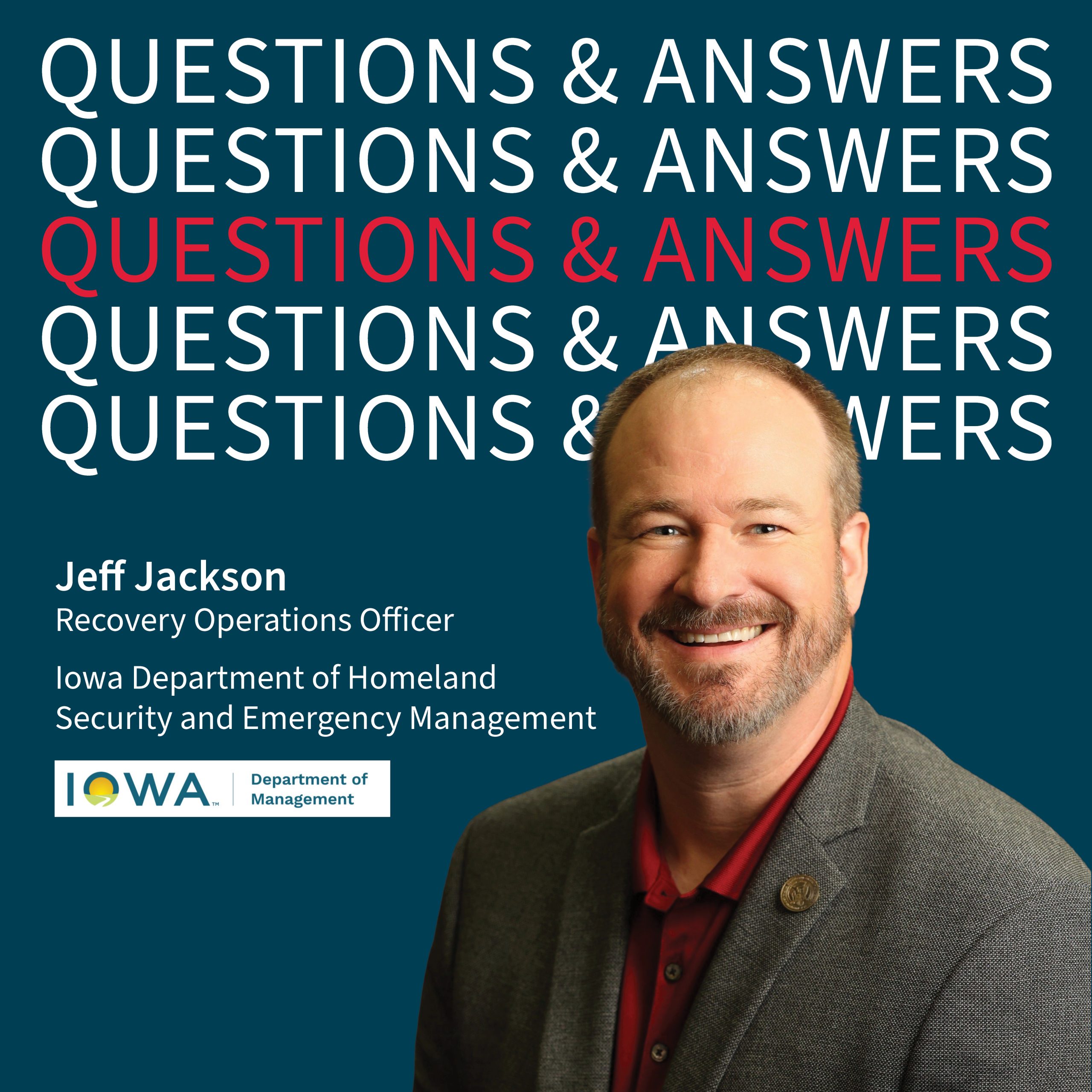
An interview with Jeff Jackson, Recovery Operations and Office of Levee Safety
Iowa Dept. of Homeland Security and Emergency Management
By Mike Bachand, Senior Engineer/Water Practice Leader
Across the United States, infrastructure owners face a shared reality: aging assets, increasing risk, and funding that never seems to keep pace with need. For levee owners in particular, these pressures are magnified by the scale of their systems and the consequences of failure. Managing a levee portfolio is not simply a technical challenge—it is a strategic one.
GEI set out to highlight real-world approaches that help portfolio managers navigate these constraints. One model stood out. Following devastating statewide flooding in 2019, Iowa took a fundamentally different approach to levee management—one focused on system-wide understanding, prioritization, and trust.

Jeff Jackson, M.S., Recovery Operations Officer and lead for the Office of Levee Safety at the Iowa Department of Homeland Security and Emergency Management.
To better understand how that approach came together, GEI spoke with Jeff Jackson, M.S., Recovery Operations Officer and lead for the Office of Levee Safety at the Iowa Department of Homeland Security and Emergency Management.
A Practitioner’s Perspective
Jeff Jackson brings an uncommon blend of experience to levee portfolio management. His background spans disaster recovery, public-sector leadership, and technical training in hydrology and meteorology. Today, he oversees Iowa’s Office of Levee Safety, a non-regulatory program created to support levee owners statewide.
Rather than focusing on individual projects, Jeff’s work centers on a broader question: how does a state make informed, defensible decisions across an entire levee system when resources are limited?
The Questions We Asked
Our conversation with Jeff focused on four core areas that portfolio managers everywhere grapple with:
- How did Iowa build a statewide levee program following a major disaster?
- How did stakeholder outreach influence program design?
- What tools helped Iowa prioritize limited funding across many levee systems?
- What advice would Jeff offer to portfolio managers just getting started?
The answers revealed several lessons that extend well beyond Iowa.
Portfolio Management Lessons from Iowa
Start with System-Wide Understanding, Not Just the Worst Assets
Following the 2019 floods—which caused approximately $1.6 billion in damages—Iowa’s legislature asked a straightforward but challenging question: What is the condition of levees across the entire state?
Rather than focusing only on known problem areas, Iowa conducted a levee study that sampled systems across western, central, and eastern regions of the state. The goal was to understand the full spectrum of conditions, from well-performing levees to those nearing failure.
As Jeff explained, this approach mattered for credibility as much as accuracy:
“To prove your point, you have to paint the whole picture. Sometimes that whole picture is scarier than just the piece you’re identifying.”
For portfolio managers, the takeaway is clear: system-wide visibility builds trust and strengthens the case for prioritization.
Funding Is Only Effective When Paired with Prioritization
Iowa’s Levee Improvement Fund ultimately totaled $35 million—spread across more than 155 levee systems. By any measure, that amount was insufficient to address all needs.
Instead of treating funding as a solution in itself, Iowa treated it as a tool that required discipline. The state developed an in-house levee rating system to help identify where limited funds could have the greatest impact. This rating system aligns with the requirements for a statewide analysis of the condition of the state’s levees in Iowa Code Chapter 418A.
Importantly, the rating system was not designed to replace professional judgment or become a rigid gatekeeper.
“This is not the decider,” Jeff noted. “It’s one piece of the puzzle.”
For portfolio managers, this reinforces a key principle: transparent prioritization frameworks support better decisions, especially when tradeoffs are unavoidable.
Outreach Is Not a Courtesy—It’s a Technical Input
Iowa’s Office of Levee Safety conducted more than 20 town hall meetings over multiple years, engaging levee owners across the state. These sessions were not simply informational. They were intentionally designed to listen.
Levee owners shared concerns about flooding history, regulatory complexity, rising maintenance costs, and coordination challenges with federal and state partners. That feedback directly shaped how Iowa designed its rating system and funding approach, including how to fairly address funding across the region to include factors like risk and condition.
“We spent a lot of time just hearing from them,” Jeff said.
For portfolio managers, Iowa’s experience highlights an often-overlooked truth: stakeholder input can materially improve technical decision-making when it is treated as data, not optics.
Non-Regulatory Support Encourages Better Information Flow
One of the most distinctive aspects of Iowa’s approach is that the Office of Levee Safety was intentionally established as non-regulatory. That decision fundamentally changed how levee owners engaged with the program.
Without fear of enforcement, owners were more willing to share concerns, deficiencies, and operational realities. That transparency improved both planning and emergency response.
As Jeff put it: “People aren’t afraid of us, so they’re willing to share information. That only makes us better in the end.”
For portfolio managers, this underscores the value of separating support functions from enforcement—particularly when building a new program.
Relationships Are a Portfolio Asset
Perhaps the most powerful lesson from Iowa has nothing to do with funding or tools.
During subsequent flood events, including severe flooding in 2024, Iowa was able to quickly assess levee conditions and respond to leadership inquiries because relationships were already in place. Information moved faster. Decisions were better informed.
“Your greatest resource is the relationships you build,” Jeff emphasized.
In portfolio management, relationships function as infrastructure. They reduce friction, improve situational awareness, and enhance resilience long before a crisis occurs.
What This Means for Other Portfolio Managers
Iowa’s experience offers a clear message for portfolio managers nationwide: you do not need unlimited funding to begin managing risk more effectively.
What you do need is:
- A system-wide understanding of your assets
- A transparent approach to prioritization
- Meaningful engagement with stakeholders
- Governance structures that enable trust and coordination
Effective portfolio management is not about fixing everything at once. It is about knowing what matters most, understanding why, and building the capacity and connections—technical and human—to act.
Jeff Jackson serves as the Recovery Operations Officer at Iowa Homeland Security and Emergency Management, where he also oversees the Office of Levee Safety. He holds an Associate’s Degree in Civil Design/Engineering, a Bachelor’s Degree in Psychology from Calvin University, a Master’s Degree in Education from the University of Michigan, and a Master’s Degree in Management and Leadership from Western Governors University. Additionally, Jeff has specialized degrees in Meteorology and Hydrology from UCAR and Penn State University.
Jeff spent the first half of his 25+ year career as a social worker and later transitioned to leadership roles at Iowa State University, culminating in his position as Director of Strategic Projects. Currently, his work centers on disaster recovery operations and maintaining the safety and integrity of levee systems across Iowa.