

Thought Leadership
What FEMA’s new levee accreditation pathway means to local sponsors
February 19, 2026
The ways that the Federal Emergency Management Association (FEMA) accredits levees has changed over time, and for sponsors of federally authorized levees, there is a newer pathway to accreditation. This updated method gives levee sponsors more flexibility in the ways they show that their levee is doing its job.
FEMA will accept a risk assessment performed using the USACE Risk Assessment methodology. This means levee sponsors will want to work with consulting teams who have performed FEMA NFIP Accreditation Risk Assessments, and who can help local sponsors understand the options that are available when it comes to getting their levees accredited.
In this blog, we’ll explore what this new pathway means for you.
FEMA has many missions in the United States. One of those missions is the mapping of areas protected by levee systems. FEMA employees are continuously updating flood maps across the nation using the latest and greatest information to keep our cities and towns safe. Are you one of the millions of people in the U.S. who lives or works somewhere protected by levee systems? If so, you’re seeing the benefits of FEMA flood mapping every day. These include:
- Inundation-driven community development
- More affordable flood insurance rates due to the National Flood Insurance Program
- Continued upkeep of levees by local sponsors with FEMA’s guidance
If you’re a local levee sponsor charged with the task of performing operations and maintenance on one of these valuable levee systems, however, figuring out the right path for your levee system to remain accredited by FEMA can be a challenge.
New Accreditation Method
For decades, FEMA has required levee sponsors to complete a deterministic evaluation of the structural requirements outlined in Title 44 Section 65 of the Combined Federal Record (CFR). Within the last ten years, FEMA worked with the U.S. Army Corps of Engineers (USACE) to update the Section 65 to accept a risk assessment of a levee system as an accreditation recommendation.
That’s a big deal. A risk-based approach lets us look beyond simple structural checks to understand how a levee really performs under different conditions.
It acknowledges uncertainty, considers how the system behaves, and focuses on real-world performance rather than pass/fail thresholds. For levee sponsors, it means more flexibility and a better opportunity to show how their system truly manages risk.
A risk assessment is a living document that a sponsor can update with new information throughout the life of the project. It also provides a thorough evaluation of the entire system and will help sponsors prioritize investments in their system based on risk-informed decision-making principles.
Charting the Right Course Through the FEMA Levee Accreditation Process
For many levee sponsors, navigating FEMA’s levee accreditation process can feel like setting out on unfamiliar waters. There’s more than one way to reach your destination and understanding which route fits your system best is a critical first step.
FEMA needs levee sponsors to demonstrate how their levee performs. The traditional deterministic approach checked the box for many levee systems in the past, but more recently FEMA began formally recognizing the value of a risk-based evaluation as a substitute for some of the structural deterministic approaches. By following risk methodology in line with a federal agency charged with levee design such as USACE, FEMA’s requirements for much of the CFR can be met. Both methods can lead to accreditation, but they differ in how they evaluate performance, document uncertainty, and communicate results. Knowing which approach aligns with your system’s characteristics, available data, and community goals can save time, effort, and resources.
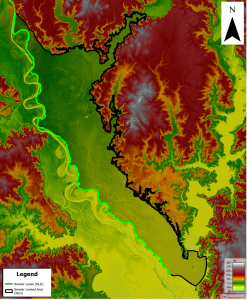
Geometry of Levee Alignment and Leveed Area, Bossier City, LA
That’s where the right partner makes a difference. An experienced consultant helps you evaluate your options, interpret technical requirements, and chart a course that makes sense for your community.
They understand how FEMA’s review process works, how USACE’s risk assessment methods can inform that process, and what kind of documentation will stand up to scrutiny. Most importantly, they can help translate complex technical findings into clear priorities for action and communication.
With the right guidance, levee sponsors can move through the accreditation process with confidence—knowing they’ve chosen the path that fits their system, meets FEMA’s standards, and keeps their community protected for the long term.
Here to Help
The accreditation process can seem daunting, but it doesn’t have to be. Adding a consultant to your team that can explain the available options and tailor a process to fit your levee needs can make this entire process more manageable.
If your community is preparing for an NFIP Risk Assessment or just trying to figure out where to begin, reach out. Our team has performed FEMA NFIP Accreditation Risk Assessments, and we can help local sponsors understand their options. We’ve navigated this process many times and can help you move forward with confidence. Email me at mboiardi@geiconsultants.com.