

Thought Leadership
How Water Districts and Other Non-Federal Interests Can Execute Feasibility Studies: Understanding The Section 203 Authority
January 22, 2026
Water management districts, flood control agencies, states, municipalities, and other Non-Federal Interests (NFIs) are constantly balancing competing priorities. On one hand, they must fund day-to-day operations—maintaining levees, managing flood risk, and protecting public safety. On the other, they are under pressure to plan and deliver new capital projects that support economic growth, environmental restoration, and long-term community resilience.
In recent years, that balancing act has become much harder.
Why feasibility studies have become more challenging
Two major changes at the federal level have significantly affected how flood risk management and coastal storm risk management projects move forward.
First, the Ideker Farms U.S. Court of Appeals decision introduced new federal guidance on induced flooding. In practical terms, this means agencies must more carefully evaluate whether a project could increase flood risk elsewhere—and whether that risk could trigger a federal takings claim. As a result, takings analyses are now being initiated earlier and more frequently in feasibility studies.
Second, a 2023 federal memorandum on cost engineering placed renewed emphasis on design maturity during the feasibility phase. Projects now need more detailed engineering earlier in the process to demonstrate that proposed solutions are realistic and constructible.
Together, these changes have had real consequences:
- Some feasibility studies were paused or stopped entirely.
- Study costs increased—often doubling or tripling.
- Project schedules stretched out, delaying urgently needed flood protection and habitat restoration work.
For many NFIs, the traditional path forward began to feel unworkable.
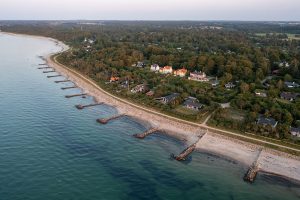
Federal investment can help reduce the risk of coastal storms in communities.
A different path forward: NFIs leading their own studies
The good news is that there is a viable way forward—and it involves NFIs taking a more active role by executing their own feasibility studies.
Historically, NFIs relied on Federal Cost Share Agreements (FCSAs) to complete feasibility studies in partnership with the federal government. These agreements helped reduce upfront study costs and, once a project was authorized by Congress (typically through a Water Resources Development Act (WRDA)), carried forward into design and construction.
This structure effectively positioned federal agencies as the primary drivers of feasibility studies. But recent policy and procedural changes have reduced the effectiveness of that approach. The result: NFIs still need federally authorized projects, but the old delivery model no longer works as smoothly as it once did.
That raises a key question: How can NFIs demonstrate federal interest and move projects forward under today’s constraints?
Preparing your own feasibility study under Section 203
Congress has already provided an answer.
Section 203 authority allows NFIs to prepare feasibility studies for water resources development projects and submit them directly to the Secretary of the Army for review. Importantly, Section 161 requires that these studies meet the same federal standards as if they were conducted by the U.S. Army Corps of Engineers.
What does this mean in practice?
- The study must follow all federal technical, policy, and legal requirements.
- NFIs still interact directly with the Assistant Secretary of the Army for Civil Works (ASA(CW)).
- The process eliminates several intermediate steps that often slow traditional studies.
With fewer handoffs and clearer accountability, Section 203 studies can often be completed faster and at lower cost, while still maintaining full federal credibility.
That said, this is not a shortcut. Successful Section 203 studies require:
- A deep understanding of the U.S. Army Corps of Engineers feasibility process
- Technical expertise across engineering, risk management, economics, life safety, environmental compliance, and real estate
- Familiarity with the federal policies and guidance governing water resources projects.
Why this is more feasible now than ever
Over the past year, many highly experienced federal professionals have transitioned into the private sector. That shift has made specialized feasibility-study expertise more accessible to NFIs than it has been in decades.
With the right team in place, NFIs can now:
- Take meaningful ownership of project development
- Control study scope, schedule, and cost
- Deliver a fully compliant feasibility study directly to the ASA(CW).
Once submitted, the ASA(CW) initiates a 180-day review period. During this time:
- Policy and legal compliance reviews are delegated to senior experts within USACE.
- The ASA(CW) evaluates whether the study demonstrates clear federal interest.
Federal interest typically means the project provides a positive net benefit to the nation. This can include traditional economic benefits as well as social and environmental benefits—such as reduced risk to life, protection of disadvantaged communities, or ecosystem restoration.
If the study meets all requirements, the ASA(CW) makes a recommendation to Congress for project authorization.
What comes next after submission
Submitting a Section 203 study is not the end of the process—it’s the beginning of the authorization phase.
At this stage, NFIs can:
- Work with Congressional representatives to pursue inclusion in the next WRDA
- Begin laying the groundwork for effective project delivery through clear communication and stakeholder engagement
NFIs can also request a Section 221 credit for the cost of executing the feasibility study. If approved, that credit can be applied toward construction costs once the project is federally authorized.
Another important opportunity is participation in the Section 1043(b) pilot program. Implementation guidance released in September 2025 established a pilot that allows NFIs to receive advanced federal funding to help construct federally authorized projects—reducing the financial gap between authorization and construction.
Moving forward
For NFIs willing to take a more active role, Section 203 offers a practical and proven path to move critical water resources projects forward under today’s federal framework.
If you’re considering this approach, it can be helpful to speak with agencies that have already done it successfully. You can also contact me to discuss how to navigate the feasibility study process and determine whether Section 203 is the right fit for your program.